Organic vs. Chemical Fertilizers: Which Is Better for Soil and Crop Growth?
Fertilizers supply essential nutrients that crops need for healthy growth, root development, flowering, and yield. But the type and quantity of fertilizer used can influence soil condition as well as crop performance.
The comparison of organic vs chemical fertilizer is important for farmers looking to improve nutrient efficiency and maintain productive soil. Chemical fertilizers supply concentrated nutrients, while organic fertilizers add natural materials that release nutrients through biological processes.
The right choice depends on soil condition, crop requirements, climate, and the farming system. Understanding how each fertilizer works can help farmers make better nutrient management decisions.
What Are Organic Fertilizers?
Organic fertilizers come from natural materials such as farmyard manure, compost, crop residues, vermicompost, and other plant or animal-based sources. Along with nutrients, they add organic material to the soil.
Biofertilizers work differently. They contain beneficial microorganisms that support specific nutrient-related processes. For example, nitrogen-fixing and phosphate-solubilizing microorganisms can help improve nutrient availability for plants.
Izumi Biosciences develops agricultural biotechnology products that support soil fertility, nutrient availability, and crop production through biological solutions.
What Are Chemical Fertilizers?
Chemical fertilizers, also known as synthetic or inorganic fertilizers, are manufactured products that supply nutrients in concentrated forms. Common examples include urea, DAP, NPK fertilizers, and muriate of potash.
Their concentrated nutrient content makes them useful when crops require specific nutrients. They can also provide relatively quick nutrient availability compared with many organic inputs.
However, fertilizer application should be based on soil conditions and crop requirements. Using more fertilizer than necessary does not automatically result in better crop growth.
Organic vs Chemical Fertilizer: Key Differences
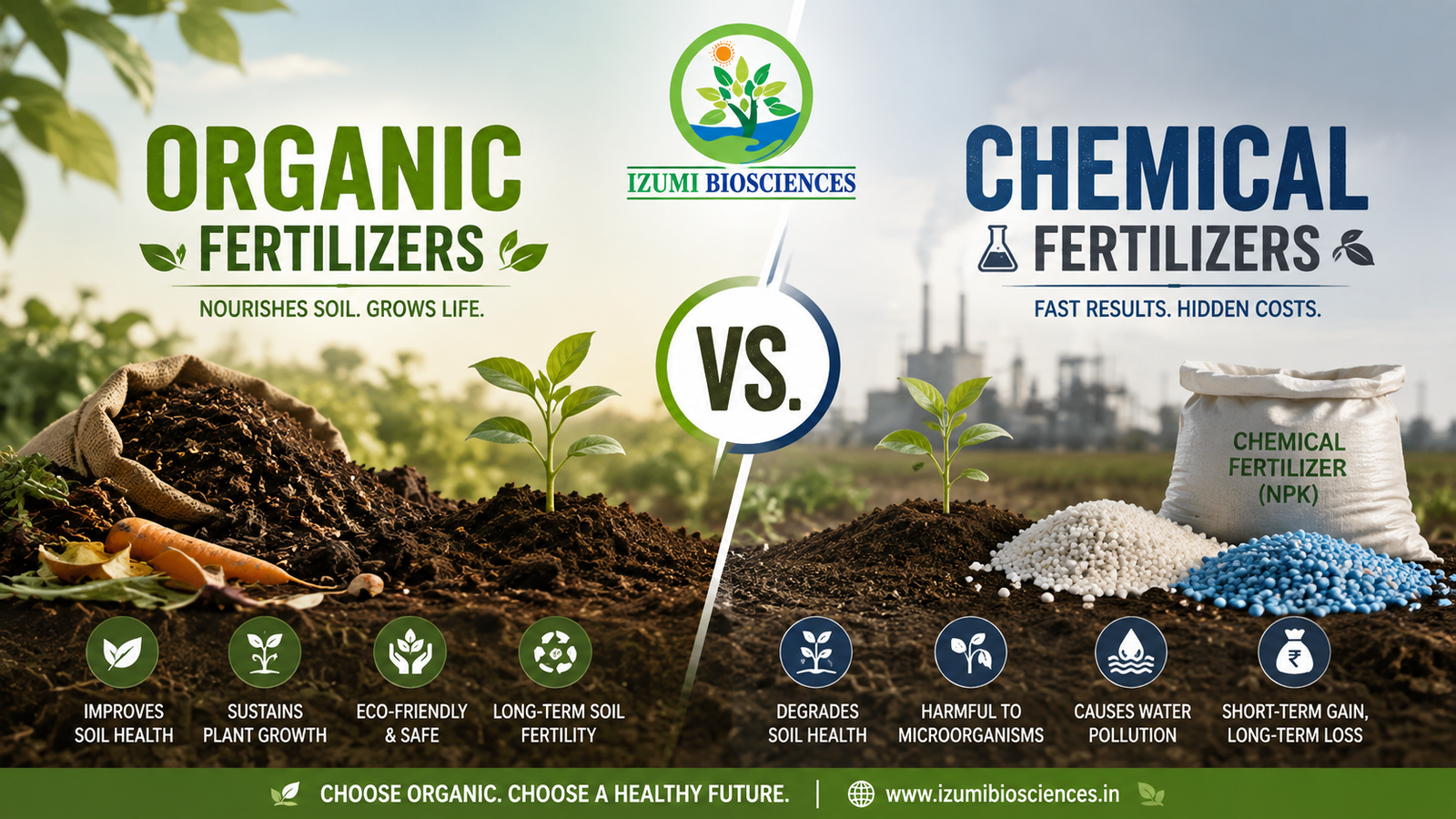
The main difference in organic vs chemical fertilizer lies in their source, nutrient concentration, release pattern, and effect on the soil.
| Factor | Organic Fertilizers | Chemical Fertilizers |
| Source | Plant, animal, or natural materials | Manufactured mineral compounds |
| Nutrient release | Generally gradual | Usually faster |
| Nutrient concentration | Generally lower | Generally higher |
| Organic matter | Adds organic material | Does not add organic matter |
| Nutrient correction | Usually slower | Often faster |
| Application quantity | Often larger | Usually smaller |
| Main role | Soil and nutrient management | Targeted nutrient supply |
Chemical fertilizers generally supply nutrients in readily available forms. Organic fertilizers release nutrients as organic materials decompose and interact with soil microorganisms. Neither type is suitable for every situation. Fertilizer selection should be based on what the soil and crop actually require.
Disadvantages of Chemical Fertilizers: What Farmers Should Know
Disadvantages of chemical fertilizer are mostly associated with overuse or misuse of chemical fertilizers. Excessive fertilizer application can also reduce nutrient efficiency and cause other problems when not aligned with soil and crop needs.
Soil Nutrient Imbalance
Nitrogen, phosphorus, potassium, sulphur, and some micronutrients are requirements of crops. Applying high quantities of specific nutrients without regard to the whole soil profile can lead to nutrient imbalances.
For instance, excessive nitrogen may lead to nutrient imbalances in the crop when used repeatedly without consideration of other nutrient applications.
Nutrient Loss
Not all nutrients applied are taken up by the crop. These may be lost through leaching, runoff, volatilisation and/or fixation in soil.
Some nutrients, for example phosphorus, could become less available once fixed in soil. Microbial inputs with phosphate-solubilizing microorganisms can support the transformation of less available phosphorus into forms available to the plants.
Pushti Plus is a product of Izumi Biosciences that contains phosphate-solubilizing microorganisms to support phosphorus availability.
Organic Matter Is Not Replaced
Chemical fertilizers are high in nutrients but don’t add organic matter to the soil. If the organic matter is continually lost, soil structure and biological activity may be impacted.
This is why fertilizer application should be combined with other practices such as compost use or crop residues and adding organic matter to the soil.
Higher Costs From Overapplication
Excessive fertilization does not necessarily lead to higher yields, but it can lead to higher costs. By applying soil tests and crop-specific recommendations, farmers can prevent inappropriate applications.
Benefits of Organic Fertilizers for Agriculture
The benefits of organic fertilizers include more than nutrient supply. Organic materials can improve several aspects of soil condition when used appropriately.
Improves Soil Structure
Organic matter contributes to soil aggregation and can create better conditions for root development. Improved structure also supports water movement and soil aeration.
Supports Moisture Retention
Soil containing adequate organic matter can retain moisture more effectively. This can help maintain suitable conditions for crops between irrigation or rainfall events.
Encourages Microbial Activity
Organic materials provide a source of carbon for soil microorganisms. These microorganisms contribute to decomposition and nutrient cycling.
Biofertilizers can complement this biological activity by introducing selected microorganisms that perform specific nutrient-related functions.
Supports Long-Term Soil Fertility
Regular addition of suitable organic materials can contribute to healthier soil conditions over time. However, organic fertilizers do not always supply every nutrient in sufficient quantities, so they should be included within a broader nutrient management plan.
How to select the proper fertilizer
The first step in selecting a fertilizer is to understand the needs of the soil and crop.
Start With Soil Testing
A soil test can provide data on nutrient content, pH, and other factors that affect nutrient requirements. This will enable farmers to determine which nutrients require supplementation.
Consider Crop Requirements
Different crops and growth stages have different nutrient requirements. Different amounts of nutrients may be required for a crop at different stages of growth, flowering, fruit development and maturity.
Use the Appropriate Nutrients
Fertilizer needs to be chosen based on the nutrient required, application rate and stage of crop growth. This may increase nutrient use efficiency and decrease the need for unnecessary application.
Maintain Soil Organic Matter
Other suitable organic inputs such as compost, farmyard manure and crop residues can help maintain organic matter. These inputs can be used in addition to fertilizers and can help to improve soil.
Use Biofertilizers (where appropriate)
Biofertilizers can be used to support biological processes concerning nutrient availability. They are affected by microbial strain, soil properties, crop type and application rate.
In the field of microbial agricultural products, Izumi Biosciences is developing products for nutrient availability and crop production.
Which one is better, organic or chemical fertilizer?
In the organic vs. chemical fertilizer debate, there is no definitive answer as to which is better. They all play a specific part in crop nutrition.
Concentrated nutrients may be supplied by chemical fertilizers when a crop has a special requirement for them. Organic fertilizers can provide organic matter and can help maintain soil properties. Biofertilizers can be used either way and can support biological nutrient processes.
For many farming systems, it is more practical to use multiple combined nutrient sources according to soil tests and the nutrient needs.
Select the best nutrition for your crop, using Izumi Biosciences.
The first step to good crop nutrition is knowledge of the soil’s needs. Izumi Biosciences provides biofertilizer and agricultural biotechnology products to improve nutrient availability and soil fertility, and crop growth.
Searching for biological solutions for better nutrient management? Find Izumi Biosciences’ biofertilizer products and select the right one for your crop and farming situation.