
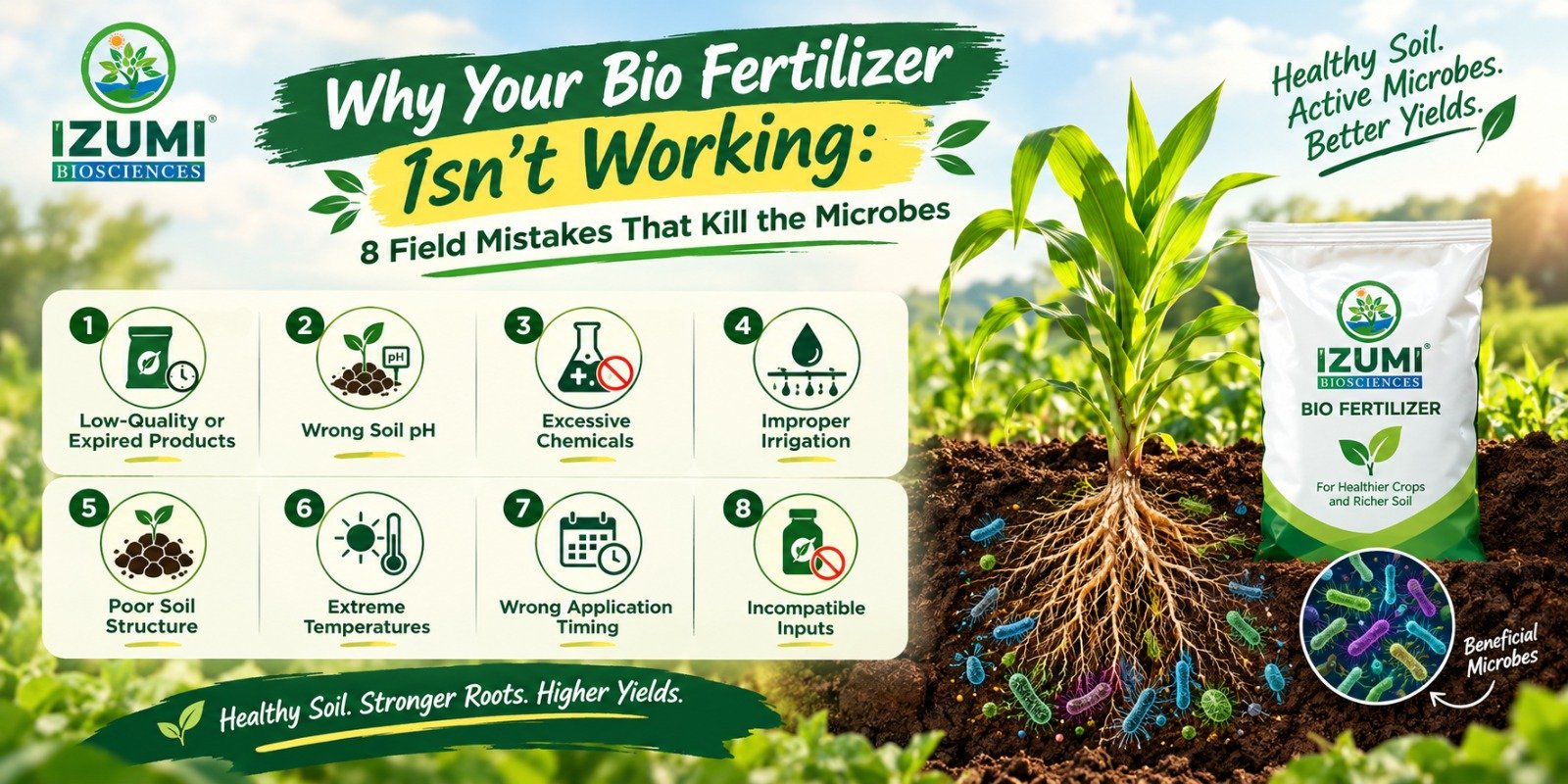
Why Your Bio Fertilizer Isn’t Working: 8 Field Mistakes That Kill the Microbes
You bought a good bio fertilizer, applied it on time, and waited. Two weeks later, the crop looks the same as the field next door that got nothing. So the natural conclusion is that bio fertilizers don’t work.
In most cases, that’s not the real story. A bio fertilizer is a living product. It carries billions of beneficial microbes, and those microbes need the right conditions to survive and do their job. When something in storage, mixing, or application kills them, the product arrives in your field already dead, or dies within hours of going on.
Here are the eight most common field mistakes that wipe out the microbes, and how to avoid each one.
1. Poor Storage and Expired Stock
This is the most common cause of failure, and it often happens before the product reaches the farmer. Microbes are sensitive to heat. A pack left in a hot shop, a parked vehicle, or a sunlit shelf loses viable cells quickly, even if the pack looks fine.
Expiry matters too. Microbial count drops over time, so an old pack may carry only a fraction of the cells printed on the label. Transport counts as well: a pack that spent days in a closed truck in summer has already faced more heat than any shelf in your home.
What to do: Buy from dealers who store products in a cool, shaded place. Check the manufacturing and expiry dates before paying. At home, keep packs away from direct sun, heat, and chemicals, and use them within the shelf life.
2. Mixing With Fungicides and Pesticides
Many chemical fungicides, insecticides, and seed treatments are built to kill living organisms. They don’t tell the difference between a disease fungus and a helpful bacterium. If you mix the product into the same tank, or coat the seed with both at once, a large part of the microbe population can die.
What to do: Don’t tank-mix unless the label says the products are compatible. If seed needs a fungicide treatment, apply the fungicide first, let the seed dry fully, and then treat with the microbial product, or ask your supplier for a compatible option. When in doubt, do a small jar test before treating the whole lot.
3. Applying Under Strong Sun or Midday Heat
Ultraviolet light and high temperatures are hard on microbes. A foliar spray or a surface application in the middle of the day can dry out and damage cells before they reach the plant or soil.
What to do: Apply early in the morning or late in the afternoon. For seed treatment, treat the seed in the shade and sow soon after. Don’t leave treated seed lying in the sun.
4. Applying to Dry or Waterlogged Soil
Microbes need moisture to move, multiply, and attach to roots. In dry soil, they stay dormant or die. In waterlogged soil, oxygen runs short, and many of the useful aerobic species struggle.
What to do: Apply a soil-based bio fertilizer when the soil has good moisture, not when it’s bone dry or flooded. If you’re applying before irrigation, plan the irrigation soon after so the microbes settle into the root zone. In paddy, the right water level at transplanting matters as much as the product.
5. Ignoring Soil pH and Salinity
Each microbe group has a comfort range. Very acidic or very alkaline soils reduce survival. High salinity does the same, because salt pulls water out of microbial cells.
If your soil has a pH far from neutral, or has visible salt patches, even a high-quality product may struggle to establish.
What to do: Test your soil before the season. If pH or salinity is a problem, correct that first with the right amendments, or choose strains that suit those conditions. A product made for general soils won’t always perform in extreme ones.
6. Using the Wrong Type for the Crop
Not every bio fertilizer fits every crop. Rhizobium, for example, works with legumes like soybean, chickpea, and groundnut, where it forms nodules on the roots. Using it on a non-legume gives little benefit. Azotobacter and Azospirillum suit other crops, and phosphate-solubilizing bacteria work on soils where phosphorus is locked up.
What to do: Match the microbe to the crop and the nutrient problem. Read the label for target crops, and ask your supplier if you’re unsure. A mixed formulation, often called a consortium, may suit fields with more than one nutrient gap.
7. Applying Together With Heavy Doses of Chemical Fertilizer
Some farmers apply the product and then add full doses of urea and DAP on top, or mix everything in one pass. High concentrations of chemical fertilizer can be harsh on microbes. A heavy dose of nitrogen can also reduce the need for nitrogen-fixing bacteria to work, so they become less active.
What to do: Don’t put it in direct contact with concentrated chemical fertilizer. Space the applications, and think of the bio fertilizer as part of an integrated plan, where it helps you use chemical fertilizer more efficiently, not as an add-on to the same heavy dose.
8. Expecting a Quick Fix, Then Giving Up
Bio fertilizers don’t act like a chemical fertilizer that shows color change in a few days. Microbes need time to colonize roots, build numbers, and start supplying nutrients. Results also depend on soil organic matter. In soil with very little organic carbon, microbes have little food, and populations don’t grow.
Some farmers also apply once, see a small change, and stop. Benefits build when you apply at the right stage, and often across seasons as soil biology improves.
What to do: Judge results over the whole crop cycle, not in a week. Add organic matter, such as compost or farmyard manure, to feed the microbes. Repeat the program in the next season and compare it against a small untreated strip in the same field.
A Quick Field Checklist Before Every Application
Run through these questions before you apply the product:
- Is the pack within its expiry date, and was it stored away from heat?
- Does the crop match the product’s target crop?
- Are any fungicides or pesticides going on the same seed or in the same tank?
- Is the soil moist, but not waterlogged?
- Is it early morning or late afternoon?
- Is the soil pH and salinity within a workable range?
- Is the product kept apart from concentrated chemical fertilizer?
- Do you have a plan to add organic matter and track results over the season?
A simple habit helps here: leave one small strip of the field untreated, and note the date, the weather, and the soil moisture on the day you apply. At the end of the season, that strip shows you what the product really did, and the notes show you what to change. If you can answer yes to most of these, you’ve removed the main reasons the product fails.
Frequently Asked Questions
1. How do I know if my bio fertilizer has gone bad?
You can’t tell by looking. A pack can look normal and still carry very few live microbes. Check the expiry date, buy from a seller who stores stock properly, and ask for a lab report or colony-forming unit (CFU) count if you buy in volume.
2. Can I use a bio fertilizer along with chemical fertilizers?
Yes, in most programs. The aim is to keep them apart at the time of application and to use it to improve efficiency over time. Follow the label for dose and timing.
3. How long does it take to see results from a bio fertilizer?
Small signs, such as better root growth and greener early growth, can show in two to three weeks. Bigger gains in yield and soil health build over the crop cycle and across seasons.
4. Can I store leftover product for the next season?
It’s better not to. Microbial count falls over time, especially once the pack is opened. Buy what you need for the current season and use it within the shelf life on the label.
5. Why did my neighbor get good results and I didn’t?
Soil moisture, pH, organic matter, storage, and mixing habits all differ from field to field. Even a small difference, like applying at midday instead of evening, can change how many microbes survive.
Protect the Microbes and the Results Follow
A bio fertilizer is only as good as the number of live microbes that reach your crop’s roots. Most failures come down to a handful of avoidable habits: poor storage, chemical mixing, harsh timing, wrong soil conditions, and short patience. Fix these, and the product has a fair chance to perform.
At Izumi Biosciences, the focus is on science-backed, bio-based solutions that hold up in real field conditions.
Not getting the results you expected? Talk to the Izumi Biosciences team and get advice on the right product, storage, and application plan for your crop.