How Biological Growth Promoters Boost Root Development and Yield
Ask any experienced farmer what separates a good crop from a great one, and sooner or later you’ll hear the same answer: it starts with the roots. You can’t see them, but they do the heavy lifting. They pull in water, hunt for nutrients, and hold the whole plant steady. When roots struggle, yield takes the hit. That’s why growth promoters have become such a big part of modern crop programs. Made from natural sources like seaweed, humic substances, and beneficial microbes, they help plants build deeper, healthier roots and turn more of what’s in the soil into harvest.
In this guide, we’ll look at how biological products work below the ground, which types are worth knowing, and how to use them well.
What Are Growth Promoters, Really?
Growth promoters are natural or bio-based substances that help plants grow better. They don’t replace fertilizers. Think of them as helpers that make everything else in your crop program work harder. A fertilizer feeds the plant. A bio input helps the plant use that food well.
These products usually come from living or once-living sources. That includes seaweed extracts, humic substances, amino acids, and beneficial microbes. Each one nudges the plant in a slightly different way, but the end goal is the same: a healthier, more productive crop.
It helps to know what they aren’t. They’re not miracle sprays, and they won’t fix poor soil or bad irrigation overnight. What they do is remove some of the limits that hold a crop back.
How Bio Inputs Build a Stronger Root System
Roots aren’t just anchors. They’re the plant’s supply line, and a bigger, better-branched root system simply reaches more soil. Here’s how bio-based products help build one.
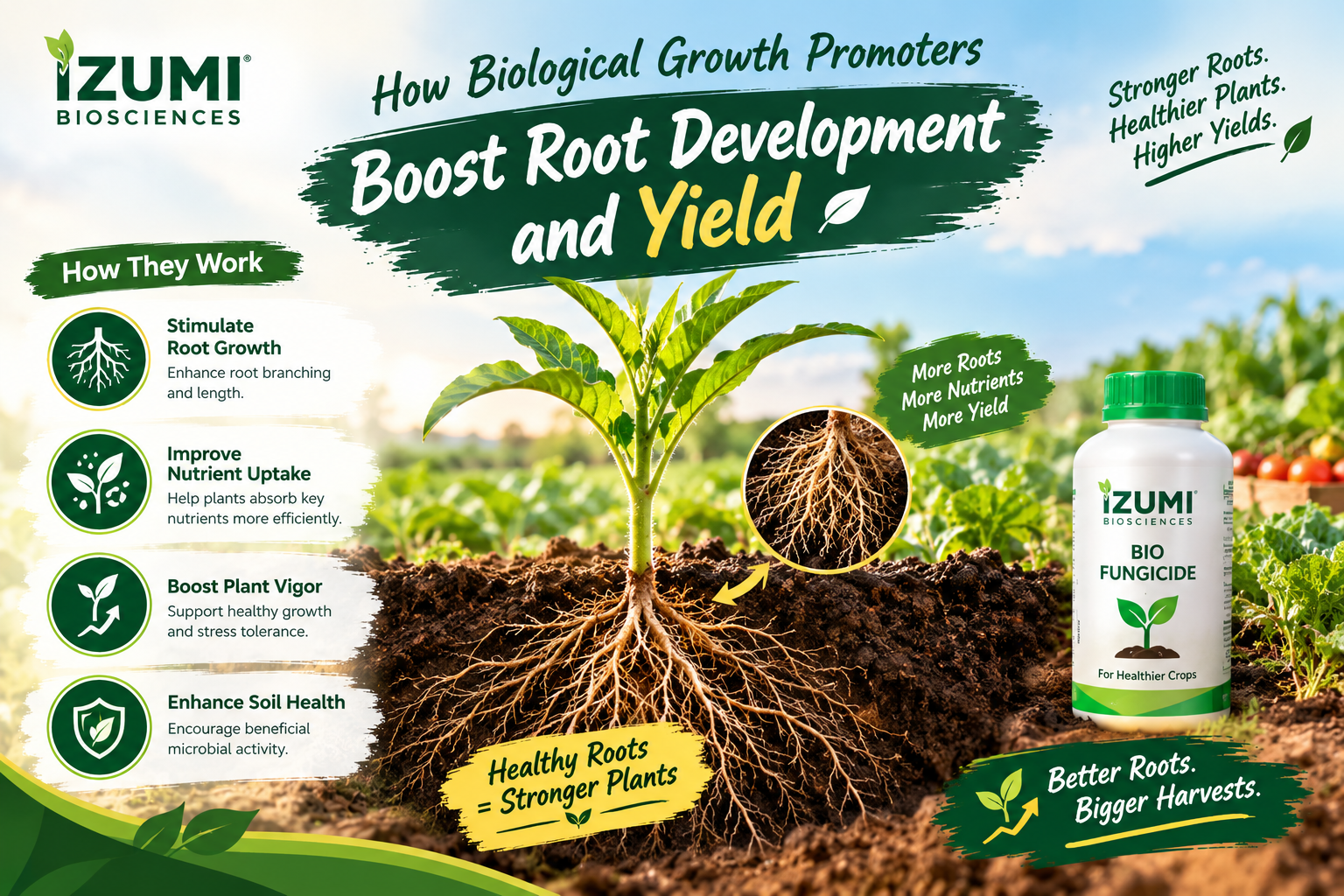
They support the plant’s natural hormone activity. Plants make their own hormones, like auxins and cytokinins, to control root growth. Certain seaweed extracts and microbial products carry compounds that back up this signaling. The result is more lateral roots and more root hairs. Root hairs matter a lot, because they’re where most water and nutrient uptake actually happens.
They wake up the soil around the root. The zone right around a root, called the rhizosphere, is packed with microbes. Beneficial bacteria and fungi live there, and they can release growth-supporting compounds, fix nitrogen, or unlock phosphorus that’s stuck in the soil. When you add the right microbes, you’re basically improving the neighborhood your roots live in.
They improve nutrient availability. Humic and fulvic substances can help hold nutrients in a form roots can reach. Amino acids give the plant ready-made building blocks, so it doesn’t have to spend as much energy making them. Less wasted energy means more goes into growth.
They help roots recover from stress. Transplant shock, waterlogging, salinity, and heat all damage fine roots. They can help crops bounce back faster, and that early recovery often decides how the whole season goes. A cotton field hit by a cold snap right after sowing, for example, can lose weeks of growth if its roots stall, while a crop with a stronger start tends to catch up much faster.
Main Types of Biological Growth Promoters
You’ll see a lot of product names out there, so it’s useful to sort them into a few groups.
Seaweed extracts. Rich in natural plant hormones and trace minerals. They’re popular for boosting root growth, flowering, and stress tolerance.
Humic and fulvic acids. These come from decomposed organic matter. They improve soil structure and help roots take up nutrients more efficiently.
Amino acid formulations. Quick to absorb, and handy when a crop is under stress or in a heavy growth stage.
Microbial products. This group covers plant growth-promoting rhizobacteria (PGPR), Trichoderma, mycorrhizal fungi, and similar beneficial organisms. They colonize the root zone and support the plant over the long haul.
Many modern products blend two or more of these. A combination often works better than a single ingredient, because each component covers a different gap.
The Link Between Strong Roots and Higher Yield
Here’s the simple chain. Better roots mean better uptake. Better uptake means the plant can build more leaf area, more flowers, and more fruit. That’s the path from underground to the harvest.
A few specific ways this shows up in the field:
- More vigorous early growth. Seedlings establish faster, which gives the crop a head start on weeds and stress.
- Better flowering and fruit set. A well-fed plant holds on to more flowers and fills fruit more evenly.
- Improved crop quality. Size, color, and uniformity often improve when the plant isn’t scrambling for nutrients.
- More consistent performance. Crops with strong roots handle dry spells and uneven weather with less damage.
Results vary by crop, soil, and how well the product is used. But the direction is consistent, and it’s why so many growers now treat growth promoters as a regular part of the plan instead of an occasional extra.
Why More Farmers Are Making the Switch
There are practical reasons behind the shift, and they go beyond yield.
Soil health is under pressure. Years of heavy chemical use have left many fields with tired, low-organic-matter soil. Bio-based inputs help rebuild the biology that makes soil productive.
Input costs keep climbing. When fertilizer prices rise, getting more from every kilo you apply matters. Bio inputs can improve nutrient use efficiency, so less goes to waste.
Markets want cleaner produce. Buyers and consumers increasingly ask how food is grown. Biological inputs fit well into low-residue and sustainable farming programs.
Climate swings are getting harder to predict. A crop with a strong root system copes with irregular rain and temperature swings better than one that’s barely hanging on.
How to Get the Best Results From Growth Promoters
Even a great product can underperform if it’s used poorly. A few habits make a big difference.
Match the product to the crop stage. Root-focused products work best early, at sowing, transplanting, or right after. Flowering and fruiting stages call for different support.
Follow the label on dose and timing. More isn’t better. Overdosing wastes money and, in some cases, can stress the plant.
Apply when the plant can respond. Early morning or late afternoon usually works well for foliar sprays. For soil applications, make sure there’s enough moisture so the product reaches the root zone.
Be careful when mixing. Microbial products, in particular, can be sensitive to certain chemicals. Check compatibility before tank-mixing, and when in doubt, do a small jar test first.
Look at the whole program. These products work best alongside balanced nutrition, good irrigation, and sound pest management. They’re a boost, not a substitute.
Common Mistakes to Avoid
A few errors come up again and again:
- Expecting overnight results. Biological products often need a little time to show their full effect.
- Storing products in hot, direct sunlight, which can weaken microbial formulations.
- Using the same product for every crop and every stage.
- Skipping soil testing, then blaming the product when a nutrient deficiency is the real issue.
Avoid these and you’ll get far more value from every liter you buy.
Healthier Roots Today, Stronger Harvests Tomorrow
Strong crops start below the surface. Biological growth promoters give roots the support they need to reach further, take up more, and recover faster, and that adds up to better yield and better quality at harvest. They also fit neatly into a farming approach that cares about the soil as much as the season’s output. Whether you grow vegetables, cotton, cereals, or orchard crops, the principle holds: look after the roots first, and the rest of the plant has a much better chance to perform.
At Izumi Biosciences, the focus is on science-backed, bio-based solutions that help growers work with nature instead of against it.
Want to see which bio-based options suit your crops and soil? Get in touch with the Izumi Biosciences team and start building stronger roots this season.
Frequently Asked Questions
1. What do growth promoters do for plants?
They support the plant’s natural processes. That includes root growth, nutrient uptake, stress recovery, and overall vigor. They help the plant make better use of the nutrients and water already available.
2. Are biological products safe for the soil?
Yes, when used as directed. They come from natural or microbial sources, and many actually help rebuild soil biology and structure over time.
3. When should I apply growth promoters to my crop?
It depends on the product and the crop. Root-supporting products are usually most useful early, at sowing, transplanting, or the seedling stage. Others work best at flowering or fruit development. Always check the product label.
4. Can I use bio inputs along with fertilizers and pesticides?
In most cases, yes. In fact, they often help fertilizers work more efficiently. Just check compatibility first, especially with microbial products, and do a small trial mix if you’re unsure.
5. How long does it take to see results?
Some effects, like greener leaves and quicker recovery, can show within a week or two. Root development and yield benefits build over the crop cycle, so give the program a full season before judging it.