How Biostimulants Increase Crop Yield
Increasing crop yield depends on more than applying fertilisers or increasing irrigation. Healthy soil, quality seeds, balanced nutrition, proper water management, and timely crop protection all contribute to productive crops.
Farmers also face challenges such as heat, drought, salinity, and other environmental stresses that can affect plant growth. Biostimulants can complement regular crop management by supporting natural plant processes and helping crops use available resources more efficiently.
Understanding how to increase crop yield with biostimulants starts with knowing what these products do, where they fit into crop management, and how they can support plant performance.
What Are Biostimulants?
Biostimulants are agricultural products that enhance natural processes in plants and improve plant performance. They are very different from fertilizers, as they are not primarily used for essential nutrients.
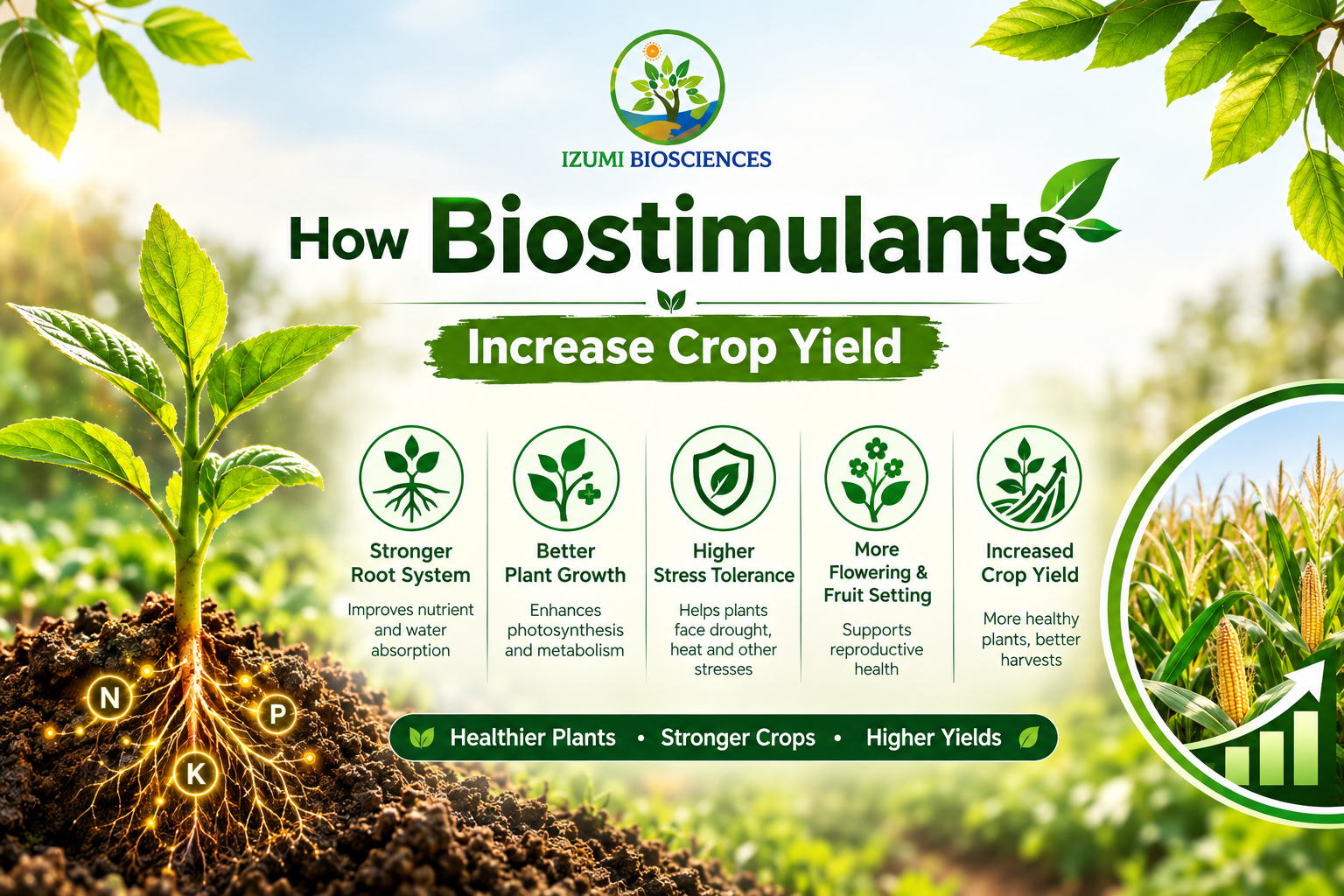
Biostimulants vary in their formulation and include seaweed extracts, humic and fulvic substances, amino acids, peptides, or beneficial microorganisms. These products may promote processes such as root development, nutrient uptake, growth, and environmental stress tolerance.
Biostimulants are usually applied along with adequate nutrition and crop management. Do not be used to replace essential nutrients in situations where a crop is known to be deficient in one or more nutrients.
How Biostimulants Can Support Crop Yield
Crop yield is influenced by several stages of plant development. Healthy roots, efficient nutrient uptake, vegetative growth, flowering, fruit or grain development, and the plant’s ability to handle stress all contribute to the final harvest.
Biostimulants can support some of these processes when the appropriate product is used at the right crop stage.
Promoting Root Development
The root system plays a central role in crop establishment and development. Healthy roots help plants access water and nutrients from the soil while providing a strong foundation for above-ground growth.
Some biostimulant formulations are designed to support root growth and activity. Better root development can help plants use available resources within the root zone more effectively.
This can be particularly useful during early crop establishment, when strong root growth supports subsequent plant development.
Supporting Nutrient Utilization
Essential nutrients like nitrogen, phosphorus, potassium, and micronutrients are required in plants at all stages of growth. But not all soil nutrients are readily available to plants in an efficient manner.
Some biostimulants can help plants in nutrient uptake and utilization. This can be used in combination with a balanced fertilisation programme and help the better use of the available nutrients in the crop.
This method may be integrated into an overall farming strategy that maximizes land and farming resources for a farmer who is keen to increase crop production in an environmentally friendly way.
Assisting Crops to cope with environmental stress
Crop performance may be greatly influenced by environmental conditions. Heat, drought, salinity, and other stresses can interfere with root activity, nutrient uptake, photosynthesis, and reproductive growth.
A few biostimulant products help plants in times of environmental stress. The impact varies with the crop, formulation, timing of application, environmental conditions, and stress intensity.
Using an appropriate biostimulant as part of a wider crop management programme can help maintain plant performance under challenging conditions.
Supporting Flowering and Fruit Development
For fruit, vegetable, and flowering crops, reproductive development is directly connected to marketable yield.
Healthy vegetative growth needs to be followed by successful flowering, fruit setting, and fruit development. Stress or poor crop management during these stages can reduce the final harvest.
Some biostimulants are formulated to support plant processes associated with reproductive growth. Applying them according to the recommended crop stage can complement nutrition and other management practices.
Farmers should follow the manufacturer’s recommended dosage and application method rather than assuming that a higher quantity will produce better results.
Bio Stimulants and Sustainable Crop Production
Farmers are increasingly looking for efficient and sustainable approaches to crop production. Bio stimulants can form part of such programmes when selected according to crop requirements.
Some products may be suitable for specific organic production systems, but not every biostimulant is approved for certified organic farming. Farmers following organic standards should verify the product’s ingredients, certification, and compliance requirements before use.
Sustainable production should also address soil health, water management, balanced nutrition, pest control, and crop selection. Biostimulants work best when these fundamental practices are already in place.
How to Use Biostimulants Effectively
The effectiveness of a biostimulant depends on selecting an appropriate product and applying it correctly. Farmers should consider the crop, growth stage, soil condition, weather, and specific production objective before application.
Important factors include:
- Crop type and growth stage
- Soil condition and nutrient availability
- Existing fertilisation practices
- Water availability
- Weather conditions
- Product formulation
- Recommended dosage
- Application method
- Compatibility with other agricultural inputs
Depending on the formulation, biostimulants may be applied through foliar sprays, soil applications, or fertigation.
Farmers should always follow the product label and technical recommendations for application timing, dosage, and compatibility.
Other Ways to Increase Crop Production
Bio stimulants are only one component of crop management. Farmers looking for practical ways to increase crop production should first establish the basic conditions required for healthy plant growth.
Maintain Soil Health
Healthy soil provides plants with physical support, water, air, and nutrients. Soil testing can help farmers understand nutrient levels, pH, and other important characteristics.
The results can then be used to develop a suitable fertilisation and soil management programme.
Choose Suitable Seeds
Quality seeds support better crop establishment and uniform growth. Farmers should select varieties according to local climate, soil conditions, growing season, and intended market.
Good establishment gives crops a stronger starting point and supports consistent development.
Manage Irrigation
Water management has a direct impact on crop growth. Both water shortages and excessive irrigation can affect roots and reduce plant performance.
Irrigation should be based on crop requirements, soil moisture, weather, and growth stage. Efficient water management helps maintain suitable moisture conditions without unnecessary water use.
Monitor Pests and Diseases
Pests and diseases can reduce yield by damaging different parts of the plant. Regular field scouting helps identify problems before they become widespread.
Farmers should inspect leaves, stems, roots, flowers, and developing fruits or grains throughout the crop cycle. Correct identification is important before selecting a control measure.
Apply Inputs According to Crop Requirements
Agricultural inputs are most effective when they are used according to crop needs. Fertilisers, bio stimulants, and crop protection products should be applied at the appropriate stage and recommended rate.
A planned approach prevents unnecessary applications and allows farmers to manage inputs according to actual crop conditions.
Can Bio Stimulants Replace Fertilisers?
No. Bio-stimulants and fertilisers have different roles in crop production.
Fertilisers supply essential nutrients that plants require for growth, while bio-stimulants support natural plant processes. If a crop has a nutrient deficiency, the required nutrient must still be supplied through an appropriate nutrition programme.
Biostimulants should therefore be viewed as a complementary tool rather than a substitute for fertilisers.
Using the two appropriately can form part of a broader crop nutrition strategy, provided the products are compatible and applied according to their recommendations.
Supporting Better Crop Productivity
Biostimulants can be used alongside crop management practices to support root development, nutrient use, plant growth, and stress response. The value depends on the crop, formulation, application time, and general growing conditions.
When farmers are researching how to increase crop yield with biostimulants, the best way to use them is to integrate them with a holistic system of soil, nutrition, water, and crop protection.
People interested in organic ways to increase crop yield should also verify whether the selected organic product is suitable for a specific organic production system.
There is no single input that guarantees higher production. Combining suitable agricultural practices and selecting inputs according to crop needs provides a more practical foundation for consistent productivity.
Building a Better Crop Management Strategy
Biostimulants may be a valuable addition to a good crop management programme. They can be used along with nutrition and other measures to ensure good crop development by supporting natural crop processes.
To maximize yields, it is essential to know the crop requirements and integrate soil, water, nutrition, pest, disease, and environmental stress management.
Looking for suitable biostimulant options for your plants? Call Izumi Biosciences today to discuss your crop needs and select the right biostimulant for improved productivity and healthier growth.